
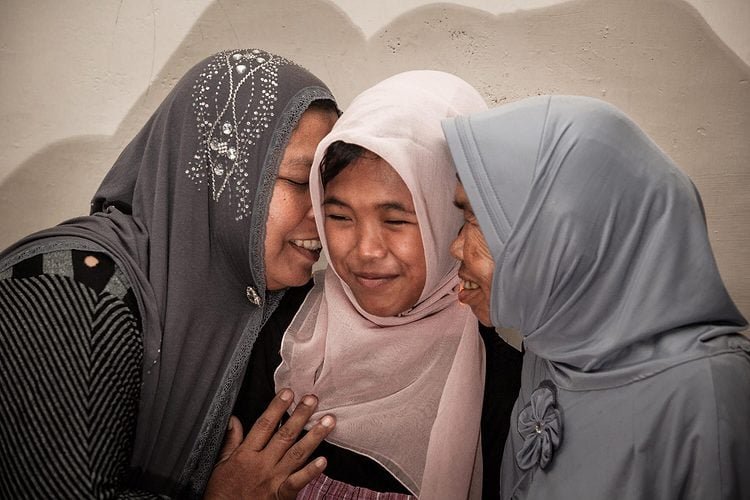
Raudhatul Jannah is best known as the Indonesian girl from Aceh who was swept away by the 2004 Indian Ocean (Boxing Day) tsunami as a young child, presumed dead for nearly a decade, and then reunited with her biological parents in 2014.
Background of the caseOn 26 December 2004, a magnitude 9.0–9.1 earthquake triggered a massive tsunami that devastated coastal areas, especially Aceh province in Indonesia. It killed more than 230,000 people across multiple countries. Raudhatul Jannah was about 4 years old at the time. She and her older brother (Arif/Arief Pratama Rangkuti, then around 7) were separated from their parents (mother Jamaliah and father Septi Rangkuti) when the waves hit their home in the Meulaboh area of West Aceh. The parents managed to escape with their younger children on a wooden plank/board, but the two older children were carried away. After about a month of searching among the wreckage and bodies, the family gave them up for dead and later moved.
How she was foundIn June 2014 (nearly 10 years later), a relative (often described as her uncle or a brother) spotted a teenage girl walking home from school in a village who strongly resembled the missing child. Inquiries revealed that the girl (then about 14) had been swept by the tsunami to remote islands southwest of Aceh, rescued by a fisherman, and raised by the fisherman’s elderly mother (named Maryam) roughly 80–128 km south of the family’s original home. She had been living under a different name (sometimes reported as Wenni) and helping collect shells.
The parents traveled to meet her, recognized her through appearance, childhood photos, and maternal instinct, and described the reunion as “a miracle from God.” They did not pursue DNA testing. She moved to live with her biological parents (who had been in North Sumatra). The foster grandmother was considered for inclusion in the new household to ease the transition after a decade together. The family also renewed hope and efforts to find the still-missing brother.
This is the widely reported “case” associated with the name Raudhatul Jannah in the context of long-term missing persons who were later found. Other people or institutions share similar names (e.g., politicians, schools, or foundations in Indonesia), but the tsunami survivor story is the notable one matching the pattern of your previous question about Mary Seow.